
Thrust Highlights
Direct Observation of Tunable Magnons in Epitaxial Spinel Ferrite Thin Films
CEEMag Team members: Li, Paudyal, Suzuki
Nano Letters 26 3073 (2026).
Introduction
Ferrimagnetic insulators offer a promising route toward low-loss magnonic devices, including magnon interconnects, as pure spin currents can propagate without accompanying charge current. We have identified low loss epitaxial spinel structure ferrite thin films as a promising medium for magnon generation and propagation. However, we need to understand the magnon modes that can exist in these materials.
Highlight
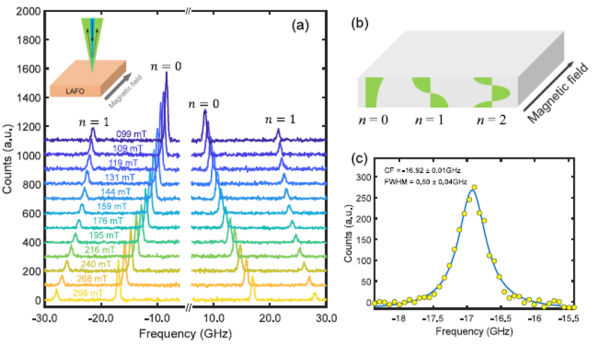
We report the first direct spectroscopic observation of magnons in low-damping epitaxial ferrimagnetic insulating Li0.5(Al,Fe)2.5O4 thin films at room temperature. Using inelastic Brillouin light scattering (BLS), the study reveals multiple thermal magnon modes that correspond to quantized standing spin-wave modes across the film thickness. The significance of this result lies in moving beyond the field’s traditional reliance on Y3Fe5O12 (YIG). Although YIG has been the benchmark material for low-damping magnonics, its high-temperature growth requirements limit compatibility with CMOS fabrication. In contrast, the demonstrated Li-based ferrimagnetic insulating films provide a new, CMOS-compatible platform for magnonic devices, expanding the material landscape for integrated spin-wave technologies.
From a materials and device perspective, the magnon frequencies in these films are highly tunable through both film thickness and external magnetic field, offering a wider tuning range than YIG. Analysis of the magnetic-field-dependent magnon spectra enables extraction of key magnetic parameters, including the magnetic anisotropy and exchange constant. Complementary first-principles calculations further elucidate the ferrimagnetic ordering mechanism and quantitatively support the experimentally extracted exchange interactions.
Together, these results establish Li0.5(Al,Fe)2.5O4 thin films as a promising, CMOS-compatible ferrimagnetic magnon platform with strong tunability and well-understood magnetic properties.
Dynamical Structural Response in Free Standing NiO Membranes
CEEMag Team members: Hoffmann, Hwang, Reid, Suzuki
Physical Review Applied 23 034075 (2025).

Introduction
Antiferromagnet insulators (AFMI), such as NiO, are promising candidates for magnon media. In AFMI, pure spin currents can propagate without accompanying charge current. They can support magnon excitations at and above THz frequencies and are robust to external field perturbations due to the net zero magnetization. NiO is an excellent candidate for tunable magnon media because of its low magnetic losses.
Highlight
CEEMag researchers have discovered a way to grow high-quality crystalline films of the antiferromagnet NiO and transfer them to different substrates without damaging the films. This technique allows ultrathin NiO films to be placed on a membrane support for electron transmission experiments. This setup enabled scientists to study the NiO lattice and its structural response when excited, which is crucial for understanding its magnetic properties.
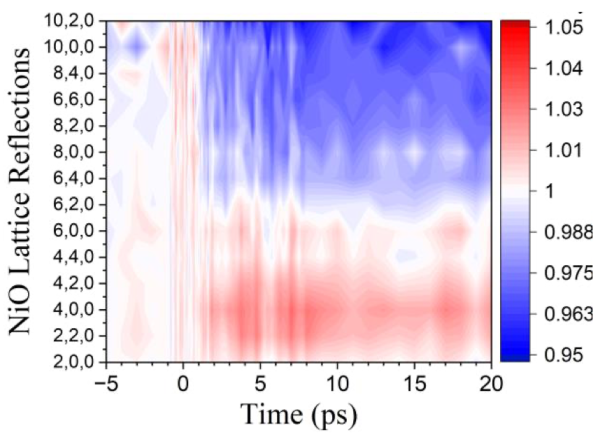
Using high-energy electrons from the Megaelectronvolt Ultrafast Electron Diffraction instrument at the SLAC National Accelerator Laboratory, CEEMag researchers imaged the atomic structure of the NiO film as it was energized by an ultrashort laser pulse. The results showed that not only did atomic vibrations increase (a thermal response), but the film also became ‘flatter’ due to laser-induced strain, which reduced the film's mosaicity. This insight into the structural response of NiO will help improve our understanding and engineering of its dynamic magnetic properties.
Octupole-driven spin-transfer torque switching of PtMn₃|MgO|PtMn₃ all-antiferromagnetic tunnel junctions
CEEMag Team members: Khalili, Fuchs, Ralph, Kawakami
Introduction
Magnetic tunnel junctions (MTJs) based on ferromagnets are canonical devices in spintronics, with wide-ranging applications in data storage, computing, and sensing. They simultaneously exhibit mechanisms for electrical detection of magnetic order through the TMR effect, and reciprocally, for controlling ferromagnetic order by electric currents through spin-transfer torque (STT). It was long assumed that neither of these effects could be sizeable in tunnel junctions made from antiferromagnetic materials, since they exhibit no net magnetization. Recently, we showed that all-antiferromagnetic tunnel junctions (AATJs) based on chiral antiferromagnets do exhibit TMR due to their non-relativistic momentum-dependent spin polarization and cluster magnetic octupole moment (CMO), which are manifestations of their spin-split band structure. However, the reciprocal effect, i.e., the antiferromagnetic counterpart of STT driven by currents through the AATJ, had been assumed non-existent due to the total electric current being spin-neutral.
Highlight
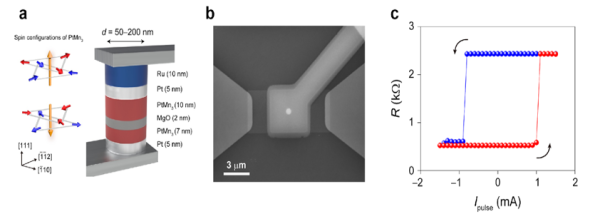
We have discovered a new current-induced torque in all-antiferromagnetic tunnel junctions (AATJs) made of noncollinear chiral antiferromagnets. This torque, which we term octupole-driven spin-transfer torque (OTT), and the associated large tunneling magnetoresistance (TMR) ratio in AATJs provide a mechanism for efficient electrical detection and generation of magnons in antiferromagnets. We observed current-induced OTT switching in nanoscale PtMn3|MgO|PtMn3 AATJs with diameters of 50 to 200 nm, fabricated on a thermally oxidized silicon substrate (Figure a and b). These AATJ structures exhibited a record-high TMR value of 363% at room temperature and switching current densities of the order of 10 MA/cm2. An example of this switching data is shown in Fig. c. We performed theoretical modeling that explains the origin of OTT in terms of the imbalance between intra- and inter-sublattice spin currents across the ATJ, and equivalently, in terms of the non-zero net cluster octupole polarization of each PtMn3 layer.
Imaging harmonic generation of magnons
CEEMag Team members: Fuchs, Flatté, Ralph
Introduction
An important goal in CEEMag is to establish new mechanisms of active control of magnon interconnects. Like any wave-based signals, an important capability is frequency conversion. In optics, nonlinear harmonic generation such as frequency doubling or tripling is a key technology that enables lasers and communication. In the case of magnons, harmonic generation has been recently observed but not well-understood.
Highlight
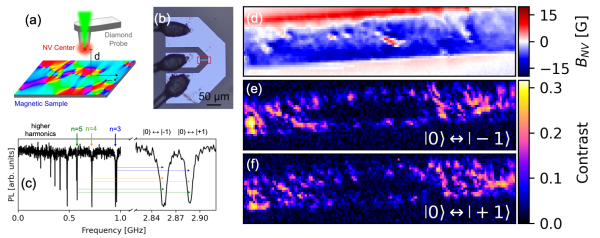
CEEMag researchers have used a scanning probe microscopy with a single spin sensor in the form of a diamond nitrogen-vacancy (NV) center to image the harmonic generation of magnons in a bilayer of Pt/Ni81Fe19 (permalloy). The spin acts as a narrow-band detector at the microwave frequency that corresponds to one of its two spin transitions (|(ms =) 0〉 ↔ |±1〉). In this experiment, the researchers detect the local microwave field emitted from the sample as a decrease in the NV center’s photoluminescence (PL). When nonlinear frequency conversion occurs, a frequency f is multiplied up to nf, where n is an integer, which is then detected by the NV center at ~2.87 GHz. Hence, the team observes dips at frequencies equal to 2.87/n GHz. Interestingly, the team found that this phenomenon is localized to nanoscale dimensions and that the harmonic intensity differs between the two spin transitions, indicating that the harmonically generated magnons are chiral. The team analyzed these results in terms of nonlinear frequency conversion process in which one drives the system in an anharmonic potential, in analogy to the related phenomenon in nonlinear optics. The team showed theoretically that one expects the observed pattern of harmonic intensity at the sample edges and that the localization occurs at positions of strong variations in the orientation of the sample magnetization. These results establish the microscopic mechanism of magnon harmonic generation and enable potential applications in efficient nonlinear frequency conversion of magnons.