

About
The scientific mission of the “Center for Energy Efficient Magnonics” EFRC is to advance the basic scientific understanding of magnon excitation, propagation, transduction, and control that is motivated by an end use of magnon-based interconnects and their integration into microelectronics.
The CEEMag EFRC has established a foundational partnership among world scientific experts in synthesis, nanofabrication, spin wave characterization and theory. The Center is comprised of a research team of PIs from SLAC National Laboratory, Cornell University, Morgan State University, Northwestern University, The Ohio State University, University of California Irvine, University of Iowa, and University of Texas Austin.
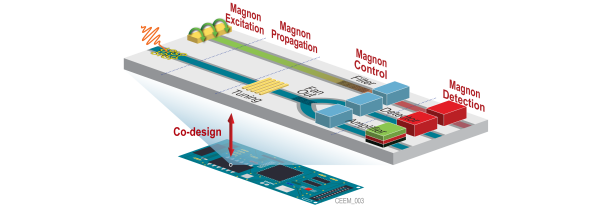
In CEEMag, we are exploring the fundamental science challenges associated with realizing magnon-based interconnects. Magnon interconnects can propagate signals with low losses and support excitations at and above THz frequencies for faster speeds and larger bandwidths. Compared to current lossy, heat producing, high latency Cu interconnects, magnon interconnects are potentially an energy efficient alternative. Losses associated with magnon wave propagation can be as low as 10-2dB/m for low damping magnetic materials. THz magnons with nanometer wavelengths are advantageous for short-distance, high-density, 3D heterogeneous integration with charge-based microelectronics relative to micrometer wavelength photonic interconnects and lossy, heat producing, high latency copper interconnects. Control of magnon wave amplitude, group velocity and phase, as well as nonlinearity and non-reciprocity, provides functionality in magnons beyond simple data transfer.


